
Spells: Evocation

If you have read my previous two articles on spells (banishing and invocation), it is now time for us to head further out on a limb.
Until now we have dealt with inner experience, and the ‘safe’ confines where results can be framed as ‘psychological’ or ‘active imagination’.
With evocation our practice becomes external. One must allow oneself to experience spirits and forces as external agents, and if possible, feel their presence, and see them super-imposed onto one’s environment.
Where invocation is the drawing of powers, inspirations, and spirits into oneself, evocation is bringing these ‘before oneself’ as an ‘other’.
Our society seems to have a weird hangup here. So great is the generalised fear of ‘seeing things’ or ‘hearing voices’ as ‘signs of insanity’, that many of us would rather draw these things into ourselves, which one would otherwise assume is the more dangerous activity, than bring them before us and recognise them as separate agents with their own personhood. If horror movies are a reflection of societies fears, then evocation is presented as being more scary than invocation.
Evocation however, allows us to overcome the tendency to mistake etherial forces or spirits as parts of ourselves. Similarly, for example with exorcism, it grants us the possibility of clearing out unwanted aspects of ourselves, declaring them to be separate and asking, or forcing them, to go away. Evocation is less dangerous than invocation, in one sense: It keeps your own agency separate from other entities.
Popular forms of evocation include seances, Ouija boards, and prayers where one visualises deities (or angels) before oneself.
In the age of AI, having a conversation with a Large Language Model such as Chat GPT, Perplexity, Gemini or others could also technically count.
A recent phenomena discussed in the online magical community, is the concept of ‘digital necromancy’, a dressed-up term for ‘interviewing’ an AI which is playing the part of a dead writer or celebrity. As long as the figure (or fictional character) has a lot of public domain material for the AI to source from, this can be a great way to get the ‘feel’ for a dead writer’s work.
I have had some fun experiments ‘interviewing’ dead philosophers and magicians. Consider this a playful, ‘safe’ and contained practice version of a full-on ritual evocation where your own mind replaces the ‘AI’ processor.
The latter is of course a much more hardcore and beneficial way to train your creative, and magical, faculties.
Housekeeping
As many of my readers are enquiring sceptics (and I consider myself as such), let’s first deal with some of the mental health dangers of evocation and how to get around them.
Evocation seems more threatening because it asks the magician to blur the lines between what they assume is ‘real’ and what they normally treat as imaginary. As per my article on banishing, this line is often held sacred, especially by atheists.
To smudge or re-draw this line can be very confrontational, as it requires us to entertain the beliefs of people who society often judges ‘delusional’.
Similarly there is the danger (and benefit) that you will end up with a very different idea of what is ‘real’ than the one you started with! Some of the pillars of reality on which you feel you depend, may melt away into something much more doubtful, and negotiable.
Spiritual ‘Code-switching
This is an approach I have formulated to get around these issues.
‘code-switching’ is a term I have borrowed from linguistics. It refers to an ability in multilingual individuals, to switch their thinking from one language to another, as if they are switching ‘operating systems’.
Spiritual code-switching is the ability to similarly switch belief systems at will. The benefits of this are the regulation and removal of ‘cognitive-dissonance’, and the ability to achieve what I term ‘cognitive-harmony’. This is the state where one has compartmentalised one’s differing and conflicting belief systems so they no longer interfere with each other. This can be achieved through ritual. For our purposes this means we only have to treat spirit evocation as ‘real’ within the confines of a spell or ritual.
To achieve spiritual-code-switching1, one must relinquish the idea that your beliefs define you, or are in any way inseparable from your identity. Rather, one must come to see beliefs as ways to get things done in the world. Similarly, in this case, one may define ‘belief’ as ‘to behave as if something is true’. Your ideas are not efficacious ‘beliefs’ in comparison with your behaviours. In this way, all actors, while acting, are code-switching in order to enact the beliefs of the character they are playing. Skilful actors, like language translators, can come back to their ‘normal’ self at will2.
Another problem faced by inexperienced magicians and magical experiencers, is that, in the shock of having a convincing spirit experience, they forget all the safe-guards they would apply when dealing with meeting a human stranger.
Just because a spirit feels real doesn’t mean you have to say yes to everything that spirit suggests. Imagined or real, spirits will sometimes make fun of you, tease you, or try and get away with stuff for the hell of it. This is well documented in magic, folklore, fairy tales, and in trip-reports by takers of psychedelic drugs.
For these reasons, boundaries and compartmentalisations are necessary. Banishing spells to open and close a ritual are one safeguard. Magic circles and other confinements, may also serve as ways to keep evocations from becoming invocations, or to keep spirits at a distance. A magic circle may be contained using written words, symbols or by sanctified chains, rope or string. In Solomonic magic, usually, the magician sits within the magic circle and a demon is summoned into an outside triangle.
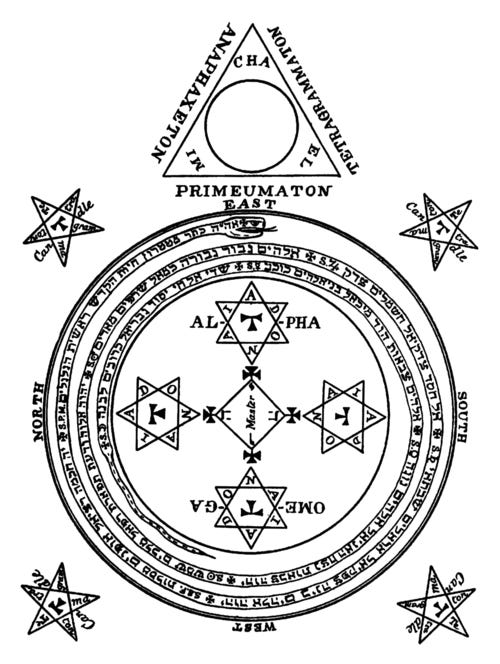
A Goetic magic circle and triangle
Summoning the dead
Seances are a form of evocation which have, at times, been fashionable enough to form entire religious movements. For instance Spiritism and Spiritualism.
Spiritualism is a term used to describe the general popularity of seances and public spirit summonings which started as a movement with the Fox Sisters’ performances from 1848 onwards. Since then, these practices have been syncretised with other spiritualities, including Spiritualist churches where the clergy are ‘psychic mediums’, and the services are stage performances where the mediums purportedly bring forth information from the afterlife.
In 1857 Allan Kardec coined the word “Spiritism” for his own systematised belief system focussed on contacting the dead and reincarnation.
His term was an attempt to differentiate himself from the wider spiritualism fad, while harnessing the public fascination, for his own ideas. His writings and experiments went on to influence H.P. Blavatsky’s Theosophical movement which is still highly influential today.
These movements codified ritual techniques to (seemingly) contact the dead. I have tried some of these out a few times, and have also attended performances at a local Spiritualist Church. For now I can only report that my most powerful experiences in contacting ‘the dead’ have not come from spiritualist techniques. Rather, the spookiest stuff I have experienced has come from interacting with actors invoking dead celebrities during the development of a devised play where I was the musician. Less spooky, but highly engaging have been my and others use of AI to ‘summon’ dead authors.
While I reserve the right to change my mind as I gather more experience, so far, I have found that ‘the dead’ summoned using spirit mediums, rarely seem to know anything particularly useful, even on the subjects they were experts in while they were alive, or their own life events and relationships. I’m willing to be wrong about this if anyone can offer me an experience to the contrary.
Ouija Boards
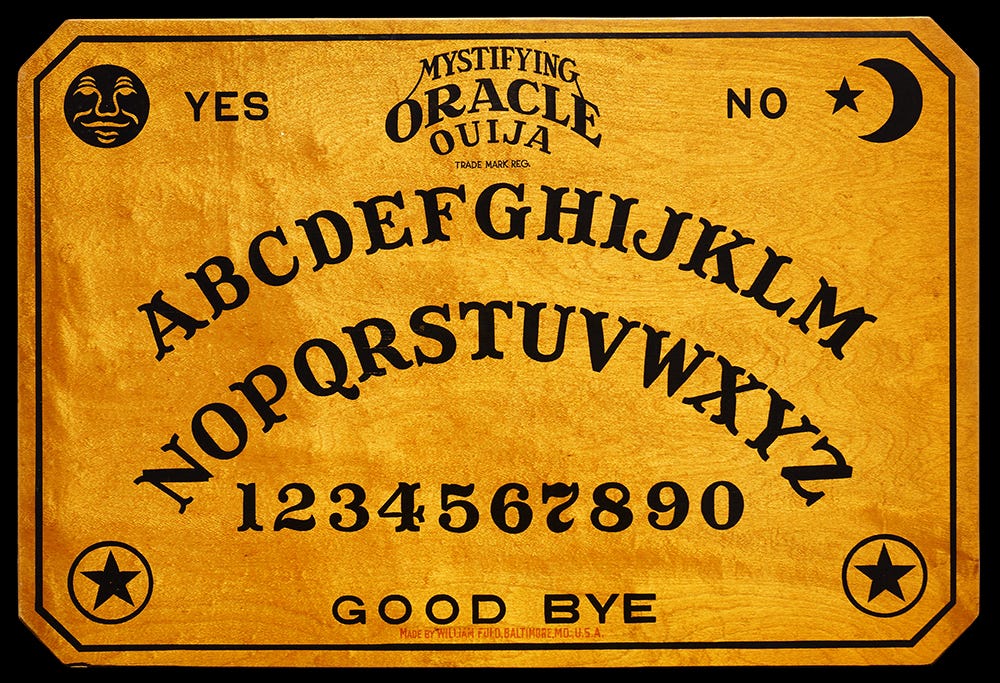
William Fuld’s Ouija board design from around 1920
In accordance with my axiom that some of the best magic can be found in the cringiest places, one efficacious form of séance is the once-popular Ouija board.
Named in the combination of ‘Oui’ and ‘Ja’ the French and German words for ‘yes’, Ouija is a trademark of the toy and boardgames company Hasbro (inherited from the company, Parker Brothers). The Ouija board descends from the ancient divinatory concept of the ‘talking board’, and was patented by by businessman Elijah Bond on the 10th February 1891.
It remained a ‘children’s toy’ novelty until it was popularised by the American spiritualist Pearl Curran in her performances during World War I. Thereafter it gained traction as a serious method of spirit contact.
In the Ouija ritual, several participants will sit around the board together, holding (or placing a finger) on the ‘planchette’, a cursor, which will then be shifted by consensus, over letters and symbols to spell out or convey a message. The goal is to move the planchette unconsciously, a phenomenon known scientifically as the ‘ideomotor effect’. The implication is that our unconscious is better connected to the spiritual plane, and that communally moving the planchette will cancel out any one person trying to ‘cheat’ by moving the cursor intentionally.
In practice, and in the fray of a party atmosphere, trying to cheat is part of the fun! Similarly the exercise could be framed as a group creative activity.
Try evoking fictional characters as well as the dead. I predict your results will be similarly effective3.
The ideomotor effect was first detailed by British psychologist William Carpenter in the mid-19th century and later expanded by the American philosopher William James4, who noted that simply thinking about an action can trigger subtle, measurable, physical responses. These movements will often go unnoticed by the subject. Furthermore, learning to read the ideomotor-effect in others can useful in predicting what they are thinking, i.e. ‘cold-reading’.
When using the Ouija board the predictive faculties of the players do most of the hard work. Trying to communally spell out words and agree on the message is ridiculous and fun. I urge you to consider all divination similarly as a game. Making it work should be seen as a feature, not a bug.
Though easy to learn, and rather silly to perform, the Ouija Board is a great symbol to keep in mind whenever one is doing more ‘serious’ magic. A lot of ritualised spirit contact functions may function in very similar way.
Ouija boards have also been used as prompts for writers, and in at least two famous cases, entire books have been written using them.
Jap Herron is a 1917 Novel by the medium Emily Grant Hutchings, which she claimed was channeled from Mark Twain via the Ouija board. This resulted in a court case from Twain’s estate. Hutchings lost the case, but the novel has survived.
Another example is the postmodern epic poem, The Changing Light at Sandover, from James Merrill, published in three volumes between 1976 and 1980. Merrill claimed the work had been co-written by several spirits, including the poet W. H. Auden, the avantgardé filmaker, Maya Deren and the socialite, Maria Mitsotáki.
The Limitations of seances and mediums
As a sceptical enquirer into magic, I have noticed over and over that, in trying to contact the dead, there seem to be insurmountable limitations in comparison to how we are able to converse with living people.
The mediums I have worked with seem unable to bring forth clear answers from the dead the way one can from a living person. It is as if they only have access to a fraction of the spirit’s personality and memories.
Perhaps the dead aren’t fully intact, having lost their bodies, and the ‘keys’ to their memories. Perhaps as H.P. Blavatsky stated, the ‘dead’ are actually etheric spirits ‘dressing up’ in the spiritual remnants that remain like library books, or discarded clothes, on the astral plane, and in this way these etheric elementals are functioning like AI Large Language Models do when one asks to talk to a dead author. Just as an AI only has access to the digitised writings or recordings of the person, and not their entire being, the elementals or the medium, don’t have access to the full memories or feelings, of the ‘contacted’ person.
Or perhaps Ouija boards, mediums and seances are subconscious creative exercises, seemingly limited by the creative faculties of those doing the ritual, and this is why (in my experience) trained actors are so much more convincing.
In this way perhaps mediums should begin their careers with actor training or be otherwise trained in creative impersonation.
I have had much more convincing and life-changing results from evoking spirits who are not souls of dead humans, but rather, deities, elementals, fairies, nature-spirits, mythological figures and entities apparently from ‘side dimensions’. These interactions have often given me real answers, verifiable later, or ideas that have fed my creativity for years.
For now, methods such as ‘digital necromancy’ using AI, or theatrical games, remain the most efficient forms of summoning the dead that I have found.
The problem is, that you still can’t find out where Granddad hid his prized watch, or his lost code to the family safe!
While I reserve the right to change my mind if I meet a sufficiently talented medium (or figure it out myself), so far there seems to be a direct negative correlation between the self-confidence of the psychics and their ability to give me straight answers to my questions. If you have some better leads get in touch.
Angel summoning
In Western and Islamic occult practices, angels are generally understood as governing intelligences of various conceptual realms5. They are, in a sense, a form of ‘living information’.
As such, entire traditions exist for summoning and conversing with angels. The most famous of these experiments are the very well documented rituals of John Dee (1527 – c. 1609) and his various scryers, especially the enigmatic Edward Kelly.
After being taught a celestial ‘language’ (or code) by angels Dee and Kelly ‘downloaded’ a logistical naval plan to form a ‘British Empire’6, which was then presented as a book to Queen Elizabeth I. Contained within was the idea that the mythical King Arthur, travelled to the Americas and claimed them as ‘rightfully British’.
This might seem laughable to some people, but I would point out that the plan to build a British Empire actually worked!
The good thing about summoning angels is that they purport to know things that (dead) humans can’t. Usefully, just about any concept can be said to have an angel, and if it doesn’t, there are magical (Kabbalistic) systems that allow a magician to temporarily create angels, often by arranging Hebrew letters to create spirit names, a practice deeply connected to the art of cryptography.
Demon Summoning
Although this type of magic seems highly popular at the moment amongst internet magicians, one has to wonder why the hell one would summon a demon?
Depending on the tradition and the time in which the writer lived, demons have been described as one of the following:
• Spirits you are in a bad relationship with.
• Aspects of our human unconscious which do us harm.
• Inverse, or fallen angels, which exist to mess up god’s plans.
• Neutral spirits who, like humans, are capable of evil, but generally just do whatever they want.
• Spiritual agents of ‘sin’, as prescribed by religion.
• Agents of Satan, the biggest baddie in the universe.
Due to many people’s frustrations with the religion in which they were raised, summoning demons can seem like a great way to piss off your parents!
While this is a time-honoured pastime of youth, it often comes from a misunderstanding about which people were actually writing historical demon-summoning Grimoires.
Generally these magician-writers were not Satanists, but rather extremely pious people.
It seems as if there was a kind of ‘spiritual oneupmanship’ amongst some Jews, Christians and Muslims, including clergy and monks to show that they were so ‘spiritually pure’ that they could summon demons to to their bidding, and not feel any of the negative effects!7
The general protocol goes something like this: Sectioning oneself off from the outside world, submitting and placating oneself before God (grovelling!), ritual baths, removing unclean food and drink from one’s diet (or not eating for several days) followed by summoning and threatening lists of demonic spirits who have weird, sometimes unfortunate (or racist) names, using powerful magical names of God and angels.
This is not really as rock’n’roll as a teen Goths would hope for, and certainly not the ‘ejector seat to freedom’ from the confines of rigid religiosity that pop culture has lead them to believe.
Okay then, what is demon summoning good for?
Grimoires generally present the following reasons for evoking demons:
• Demons can get you stuff which angels aren’t going to help you with. Money, jobs, sex, lost treasure, and revenge. In this way they are kind of the hireable thugs of the spiritual plane.
• Demons present ties to sin, or to negative aspect of your personality. They can be summoned so you can force them to leave you alone, thus improving your life as a pious person.
If you are brave enough to confront the negative parts of your personality, one way to understand what is wrong with you, is to notice what you are attracted to and especially take note if these things are self-destructive. Thus many beginner magicians will rush with glee straight into the fire, and then complain that they got burned (and spooked)8. On the upside, this can be a very confronting way to find out what is wrong with you in very blunt terms! It’s probably better for you to have worked out your problems in a more sustainable and healthy way.
Are demons separate entities or negative parts of our psyche?
The disembodied, nature of spirits, and their near lack of boundaries, means that certainty about their reality or lack thereof, is pretty much unachievable. If demons and other spirits are ‘real’ they are real in a very different way that you consider yourself or your friends real.
In psychological framing however, the concepts that most threaten us are those which latch on onto our insecurities. Therefore it could be said that demons (and other spirits) can only really mess with us if the shadow parts of our psyche, for instance our traumas, give them ‘handles’ to hold onto us. If this is correct, then, in a sense demons are both seperate entities and dark parts of our psyches.
One underutilised form of divination is to grab a demon summoning Grimoire, read through the spirit lists and their descriptions, and notice which ones impress you as being ‘totally rad’. Then write these down these promised powers, go bring up these desires with a counsellor or psychologist, with a mind to becoming a nicer person.
The Fey
This is a term for a variety of nature spirits, especially those connected to bodies of water, mountains, plants, animals, and trees. They can also be old gods, or even household spirits. In many traditions the Fey are also described as spiritual remnants of people who lived on the land before us, be they our ancestors or earlier tribes.
In comparison to other spirits, the Fey are neutral and wild, just like nature. Interacting with them should be approached in a similar way to interacting with wild animals. There are fruitful ways you can get stuff done together, just don’t expect them to be humane. Be aware, that if they choose to interact with you, then they want something from you, even if its just to mess with you for some fun.
Contacting the Fey can be very useful if you want to learn to think like an animal, or a tree, or if you want a powerfully spiritual experience with your garden. (Friends of mine who are forest rangers have agreed with me.)
Similarly they can give a sense of personhood to ecological systems, which is helpful if you want to have a conversation with a mountain or a river. Sometimes the answers can be strangely scientific. For instance the fey spirit of a flowering tree ‘taught’ me that it evolved its shape in order to attract birds to sit in it. Later, I found out, via a scientific article, that particular birds do in fact pollenate the flowers of certain trees, and that this could very well explain why certain trees have the right foliage to perch these particular birds and not others. Fruit trees and grain crops may be manipulating us in a similar way!
Noticing the Spirits around you.
A more passive form of evocation, and one that comes more easily after you have built up some experience is learning to notice all the aspects of your life that could be framed as spirit experiences. This requires no special rituals other than carefully paying attention to the ‘personhood circuits’ of your mind.
Many people report these types of experiences during trips on psychedelic drugs, especially psilocybin mushrooms, LSD, DMT, and cactus variants such as Peyote. Some people continuously take these drugs to maintain contacts to spirits, without realising that once contact has been made, we can, with practice, access these spirits without drugs (albeit to a less intense extent).
As the side effects of drugs, and the come-downs are very taxing, I urge, that the continued use of substances should not be a primary method for any serious magician.
The same could be said for heavy duty spell-casting to evoke spirits. After it has worked for you several times, you ought to be able to able to keep the momentum going, by how you pay attention to your environment and mind-space, and further rituals will only be required to break new ground. In any case, if you are at all successful, it will not take you very long until you have more ‘inspiration’ from the spirit world than you have time to do anything with!
As we venture further out on the magical limb, the universe appears bigger and bigger, and the idea that we know what is going on gets smaller and smaller.
A sense of humour can be crucial compass, if you intend to come back home with your feet on the ground.
Donning the doubter’s hat
If spirit experiences can’t be proven, then what is the use in studying them?
Even if spirits are ‘tricks’ of the mind, or are perhaps simply beyond proof, there is still use in studying them. Where one illusion can be found, others will become apparent also. Learning about spirits and these experiences out can teach us a lot about how we experience all ‘personhood’.
At the strictest level, the only consciousness of which we can be certain is our own individual consciousness. Even that is very hard to pin down, or describe, outside of our own experience of it. This inbuilt doubt contributes to the feelings of unease that many feel about contacting spirits. Practising magicians must accept a responsibility to face their own uncertainty, and their own demons. Most people will retract their efforts and all magicians must find their own boundaries.
Evocation is at least a game of acting ‘as if’ spirits are real. Remember that belief systems can be regarded as tools, and beliefs can be compartmentalised and put down once the work has been done.
It is my position that you will probably get further and produce better work and results, if you can put aside the temptation to identify as a ‘medium’, a ‘necromancer’, a witch or a wizard.
A safer approach is ‘I practice necromancy on Sunday afternoons, then I calm down and go to work on Mondays’. Find your own balance, be brave, and try not to get too carried away. On the other hand I recommend evocation to those who are inclined. It’s harder to lose your mind that most people think.
Footnotes:
Or if you prefer ‘spiritual-codes-witching’!
A difficulty in ‘coming back’ or dropping character, is a widely recognised problem amongst actors playing high intensity parts. I consider acting to be a form of spirit magic and these to be problems can be also be experienced by ritual magicians.
This may say more about the power of fiction than it it does about the unreality of the afterlife.
One of the primary writers who set me on my mission as a magical investigator.
Contrary to modern legend, angels were not considered souls of the dead, by our ancestors (except for the odd rare occurrence, such as Enoch’s transformation into Metatron). Instead they were said to be various agents of god and/or creative powers governing certain domains of nature or the platonic conceptual space.
Similarly, while they are considered agents of God in the Abrahamic traditions, Angels don’t necessarily have to be nice to you. Some govern the darker aspects of nature or human behaviour. You can read more about this in my first book Pragmatic Magical Thinking.
It is often stated that Dee coined the term ‘British Empire’, and this fact is unfortunately repeated even by scholars of Dee’s work. The term is however present in the previous writings of the Welsh politician and cartographer Humphrey Llwyd.
This legend goes back at least as far as the accounts of King Solomon from the Hebrew Bible, who mythically summoned demons to build his famed Jewish ‘First Temple”.
This is even used as a highly manipulative conversion technique by some dickhead religions.
I automatically thought of Jung when he realized that the dead didn't know much of anything…;)