
Spells: Invocation

Invocation is a type of magic whereby the magician brings a spirit, or an archetype into themselves, in order to affect their environment, behaviour, pattern recognition, influence, luck, or their abilities. Inherent to invocation, is the idea of ‘merging’ with powers from the spirit realm (or the world of concepts, which I argue is nearly the same thing).
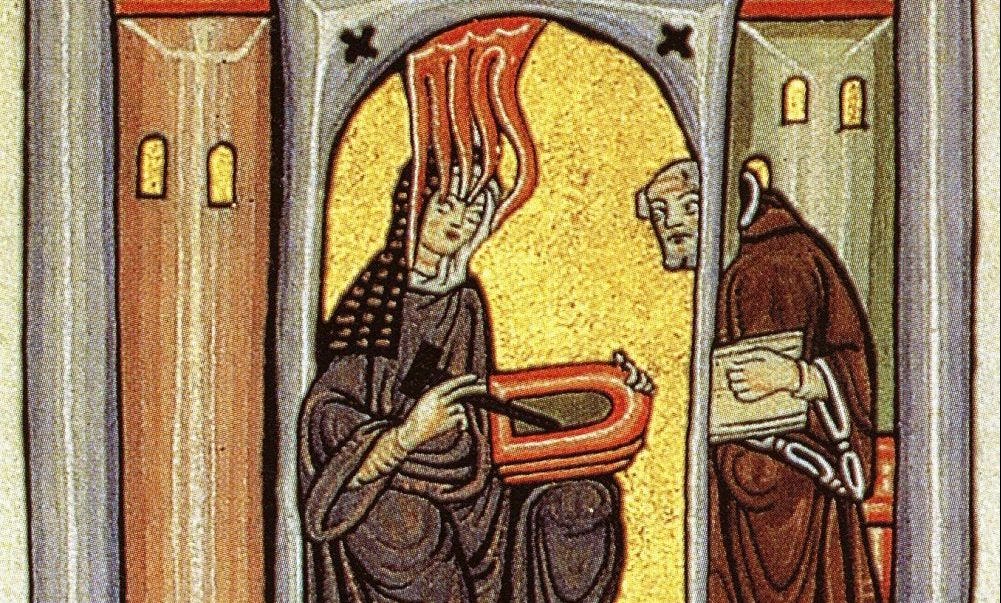
Hildegard von Bingen’s depiction of an invocation of the Holy Spirit
Invocation can be thought of as the opposite of banishing. After beginning to train one’s awareness, and learning to remove unwanted influences, invocation is the next important skill in magic.
Learning a symbol set
As I have previously discussed, magic is deeply tied to associative and symbolic thinking. A spell can be understood as having one or more symbols work on one’s perception. Examples of symbols commonly used in magic are: The cardinal directions, love, Gods, spirits, chakras, alchemical elements, astrological symbols, sephiroth, magical words (including made up words), sigils, images, and chants. To undestand western magic, I suggest you start with the alchemical elements and the seven classical planets in astrology.
Let’s explore the symbolism of the four elements (an except from my book, Tarot for Sceptics):
• Fire represents the first drive to action, inspiration and the energy to change one thing into another. Fire acts and imposes itself on its environment, actively changing it. In human beings, it is the willpower, artistry and craftsmanship. In our modern era, Fire also incorporates electricity. In physics, Fire would be the phase of plasma, and energy. In human behaviour, Fire is assertiveness, aggression, passion and anger.
• Water responds to its environment and allows its form to be changed to conform to its surroundings. It represents the emotions (tears), which are our reactions. It also represents emotional relationships. It is aesthetics in the arts. It is the ‘feeling’ stage of getting something done. In physics, Water would be the phase of liquid and fields such as gravitation and electromagnetism. In human behaviour, Water corresponds to love, relationships, joy and sadness.
• Air is the least tangible of all the elements. It represents the mind, ideas, teaching, language and the realm of pure concept. It is the planning stage of getting something done. In the modern era, Air also incorporates flows of information such as the internet. In physics, Air would be the phase of gas and information.
• Earth is the most tangible of the elements. Earth can be cut or divided into separate objects that stay separate. It is the practical doing stage of getting something done. It is the manifestation of will. In Kabbalah, Earth is described as the combination of the other three elements. In [Tarot] readings, Earth is our resources, time, money and energy to get things done. Traditionally Earth is associated with shields, protection and also stone. In physics, Earth would be the solid phase, and all matter.
---------------------------
Spirits, archetypes and concepts
A spirit is a bunch of concepts that can be embodied or talked to as if it is a person. In this wide definition, Batman is a spirit, as are all fictional characters, and so are AI (LLM) chat engines. In a very real sense, the world of our ancestors was described as being full of spirits in order to explain the same phenomena that we now describe in psychology. For instance, ADHD is a set of traits that can be embodied by people, as is stress, psychosis, pleasure and elation. In the past these could be described as being under the influence of elemental powers. Melancholy was considered to be an overabundance of the qualities of the element Earth, and the planet (and god) Saturn. The cure was to decrease foods, situations and behaviours associated with these powers and balance them out with their opposites, in this case the Sanguine element Air, and the planet Jupiter. To take a melancholic person out to hang out with friends, is a very, Airy, and Jupiterian approach, and also still seems like common sense today.
In Norse mythology, Thor (Þórr) is the god of thunder, strength, protection (as the defeater of invaders), and temper tantrums. Magically speaking, from the right side of the brain, it is intuitive to most people how a thunderstorm can feel angry. Thor is described as being red-headed. This also describes his temperament. He was said to be prone to rage. When a toddler is throwing a tantrum, it is quite correct, magically-speaking, to say that they are ‘being a little Thor’, and to understand this behaviour as an invocation of Thor.
It is also worth understanding that the toddler is practising negotiation, albeit with a very limited toolset; their body and voice. As our physical manifestation and our strength, the body is one of our most powerful tools for enacting our will and obtaining our desires.
The toddler however will eventually come up against social mores. There are very specific rules about how you can use your body and voice to demand what you want. These rules could be understood as the Norse god Forseti, who acts as a formal judge of truth, order and reconciliation. In comparison to the toddler, a seven year old has hopefully learned how to plead their case for an icecream: “I haven’t had one for a week, I’ve been good, and the neighbour kids have icecreams!”. The child’s ability to negotiate, (or manipulate) could be understood as invoking Odin (Óðinn).
And so goes this line of thinking until your whole universe has become infused with spirits, acting out events and informing the drives and behaviour of all living things and nature around you.
So, moving forward, pick a pantheon, (Greco-Roman has the most resources, and aligns to astrology), learn the various personalities and qualities of the gods and you will start to notice how the patterns of reality can be described by their traits.
Inspiration
Although our modern society1 is usually thought to be mostly secular, there is a lot of magic hidden in the etymology of our words. To be ‘inspired’ was originally, in Latin inspīrō, more or less to ‘breathe in a spirit’ (the word spirit being derived from the word for breath), thus all inspiration can be thought of as invocation. Similarly, to be ‘enthused’ (from ἐνθουσιάζω) was ‘to take in a god’.
All creation of art can be framed as invocation. Therefore, in a wide sense, making art is a type of spell. Similarly the invocation is recognised by, and affects the person who observes the art.
Superman can be understood as modern dressing of Hercules, and therefore, as an established symbol, art depictions of Superman summon the quality of peak human strength and power. It is worth noting that the names by which we call archetypes or spirits are secondary to their qualities. Therefore Hercules, Superman, Thor, and an olympic powerlifter, all draw from the same core ‘Strongman archetype, despite being referred to in numerous ways.
What can go wrong
The symbol sets in magical practice are relational and general. Thus invoking the powers of Jupiter might help you increase your circle of friends, and your luck, but might also coincide with a thunderstorm. Mars might increase your personal drive to train in competition, but might also coincide with having more arguments.
In my experience (so far) there’s no perfect way around this. Thus the magician who invokes Jupiter ought to pack a raincoat, and the magician who invokes Mars may want to avoid social media for a week. Noticing the effects of magic is a right brain exercise, and this part of the mind is relational, and focussed on the big picture rather than fixed details. Overuse of analytical (left brain) thinking inherently involves narrowing the attention in a way that will usually cause one to miss magical results. The only way around this is practice focusing one’s attention and behaviour on specific results and learning to avoid irrelevant influences.
My personal mantra is “cast a wide net for what you want, whilst being ready to dodge the shit”.
Trying things out
As one is learning magic, it is advised to invoke often and to keep notes. You might invoke Mercury, or Venus (or both at the same time) in order to find out what will happen. There will surely be repercussions, but that is part of becoming a magician, which requires both radical bravery and accountability. Pretty soon you will learn which powers you enjoy, and which you don’t, as you modulate your reality tunnel. Similarly, the magicians who achieve the most with magic, are those who are extremely quick on the uptake, and adaptable.
Ritualised habit-forming
Every wilful act (and many unconscious acts) can be framed as invocation. This is part of the subtext behind definitions of magic such as Crowley’s: “the Science and Art of causing Change to occur in conformity with Will,” or Dion Fortune’s “The art of causing changes in consciousness in conformity with the will”.
Symbolically acting out one’s desires in ritual is, neurologically speaking, an efficient way to change your habits. This works much better than arguing with yourself in your mind-space. Combining the powers of banishing and invocation is like being handed a bunch of levers to modulate yourself, your emotions, and your environment. For instance, I like to think of the invocations of the seven classical planets as an ‘equaliser’ similar to an EQ on sound equipment.
Too depressed? Banish Saturn and Invoke Jupiter. Need extra charm for a public talk? Invoke Venus and Mercury. Need help in getting fit? Invoke Mars and Earth.
Examples:
In the magical system of the Hermetic Order of the Golden Dawn there are modular rituals for invoking powers such as the elements, the seven classical planets, the signs of the zodiac and the ten Sephiroth of the Kabbalistic Tree of life. These can be a very good place to start as they were specifically put together to train magicians.
Many of these rituals can be found at the website for the Hermetic Order of the Round Table (to which I am unaffiliated). They differ in minor aspects from some of the Golden Dawn spells on which they are based, but they are very close. I’ve have found these extremely useful, and I’ve tried nearly all of them. The prescribed order for invocations is to start with the Pentagram Rituals (for the elements), and then progress onto the Hexagram rituals (for the astrological powers and sephiroth). You are supposed to banish the powers at the end of the spell. I have however sometimes kept them open to see what would happen. Banishing at the end of the spell will focus the powers like a laser, whereas keeping them open will light up everything around you like a light bulb. Both can be useful depending on the need.
The Golden Dawn was/are very particular about training the student magician gradually over several years. This is fine and well, and perhaps even the best way. However in our very secular, ‘disenchanted’ world, some people need to be shown the effects of magic before they will commit. This more chaotic approach can work as long as the magician takes radical responsibility for their results.
If that is you, at least go back and read my article on banishing before you start.
A more gentle way into magical practice is to begin to recognise the magic you and people around you are already doing. Which powers are you already acting out in the world? Once you understand these, you can then try turning some levers up and some down. Keep record of your results. You would be surprised how easy it is to forget about, even spooky, outcomes.
Good luck, and may you get what you desire.
Footnote
1I’m from New Zealand. Your mileage may differ in other parts of the world.