
Inversion Without Liberation

Rebellion can be a very powerful force for evolution, both personally and culturally. It affects politics, generation gaps, art movements, media, fashion, and family dynamics. It’s also one of the ways that people, especially teenagers, form their identity.
Rebellion has also been a constant theme in religion and magic. Here I want to address a common trap that rebellious intention falls into, and how to overcome it.
Becoming what your parents hate
Imagine for a moment that you grew up in a football-obsessed family, as a kid who always hated sports. Your Father, Mother and older siblings are Manchester United fanatics. Since you were a toddler you were dragged along to games, forced to wear the red, white and black scarf, and coerced to sing, shout and chant at every game.
By age fifteen, you’ve had enough! It’s time to rebel. You hate the whole game of football, but because everything good about the game has been framed to you in terms of the Manchester team, the most accessible power-move seems to be to go out and buy a Liverpool team jersey and start cheering for them instead. Initially it seems to work. Your parents are riled up! Finally making your own bold decision, you feel powerful and energetic. You’ve set a boundary, you aren’t like them!
After a few months like this, the once liberating feeling of cheering for the enemy begins to fade. Despite your rebellion, you are still trapped in the same game.
Then you meet a bunch of theatre kids who never go to sports games. Suddenly a whole new horizon opens up. You realise it wasn’t Manchester United you hated after all, it was the whole game of football.
This situation is inversion without liberation1.
It’s a situation that plays out over and over in all cultures. If you hate something, it seems like the easiest way to fight it is to invert the values. Everything that was once bad, is now good. Everything that was good is now bad.
The problem however still remains. You are still playing the game you resent. Your enemies still set the rules and you haven’t transcended them. This solution is shallow, not freeing.
The Church of Atheism
The French revolution of 1789-1799, was a bloody push against historical corruptions in the institutions of religion, aristocracy, and monarchy. Though enormously powerful historically, the rebellion ultimately failed: Napoleon and his dynasty seized power from 1799 onwards, restoring both Catholicism as the religion of France, and his new form of governance which amounted to just another form of hereditary monarchy.
Part of the French revolution’s failure was surely due to an inability to properly replace the institution of religion, first Catholicism and then Protestantism as well. They did however, try.
The first attempt was le Culte de la Raison, (the Church of Reason). A new church whose primary faith-based tenet was that Christianity was bad. All crosses were ordered to be removed from the graveyards, and the cemetery gates were to bear the inscription "La mort est un sommeil éternel" (death is an eternal sleep). As well as exercising iconoclasm, they tried their damndest to fight religion by being religious. In public ceremonies, often in old cathedrals, girls costumed like priestesses in Roman garb, paraded around another girl dressed as a Goddess of Reason.
At the time there must have been a feeling of finally getting one over religion. The old ceremonies would have been pointed out to be ignorant and gullible, whereas the new ceremonies were enlightened and symbolic.
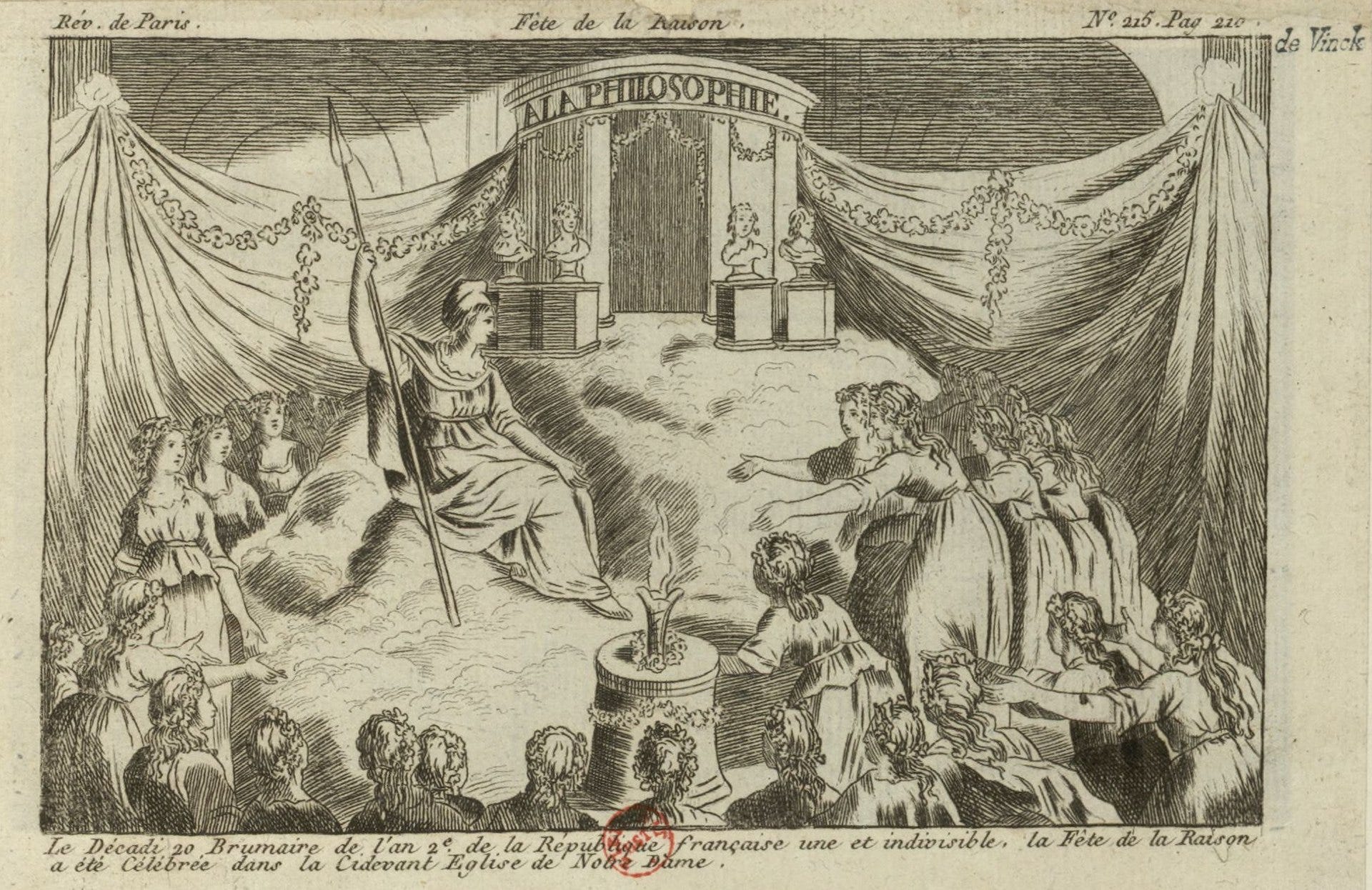
The problematic historical battles between Catholics and Protestants soon found their echo however, even in this atheist rebellion against the old state religion.
A rival ‘secular religion’, soon appeared in Culte de l'Être suprême (Cult of the Supreme Being) established by Maximilien Robespierre.
Where the Cult of Reason worshipped no gods, only reason, the Cult of the Supreme Being was deist. Robespierre, reacting to the reaction, thought that a belief in a supreme deity, and a belief in immortality of the soul, was necessary for public order. He was known to quote Voltaire,
"If God did not exist, it would be necessary to invent him".
In retaliation he put on his own public ceremonies. Fighting religion by religiously fighting another cult that also religiously fought against religion!
Both movements only lasted a few years before Robespierre was arrested and executed by his fellow revolutionaries. Then Napoleon seized power, both cults were banned and Catholicism was restored.
It seems that fighting religion, by founding religions, doesn’t set you free from religion.
Irony can be a trap
I was born at the very end of generation X. A generation defined by a loss of faith in the meaning structures of our ancestors. Hippy idealism had failed to build a utopian society. The job market was trashed. We grew up being told the world was going to end, perhaps by nuclear war, perhaps by environmental disaster (how the zeitgeist repeats itself!). The boomer generation who had been allowed financial responsibility at a young age were going to hold onto that power as long as they could, and thanks to modern medicine, diet and safer jobs, they have been living longer than any other generation on record.
As youth, there seemed to be no way to come into our own power. So generation X was sold irony. The establishment was ridiculed. Nothing was sacred. There was a short fleeting pleasure in making fun of sacred cows. Inversion without liberation.
The spokespeople were crass comedians like Rik Mayall and the Young Ones. Sardonic rockstars like Kurt Cobain who took to trashing his guitars, often taunting his fans with deliberately bad performances, and moaning about how he had gotten famous against his will, by trying very hard to get famous!
MTV and popular films showed us slacker culture. If you felt angry, you should bum out and waste time in quiet wimpering protest. Rave culture and electronic dance music seemed to offer a new world at first, but the seeming infinite possibility of electronic music soon became formalised to strict genres and strict BPMs by DJs. The very technology that allowed the freedom to create ‘Electronica’ funnelled the music into standardised genres. The once inventive artists often became buried by repetitive motifs, for instance the same two funk drum-break samples (the Winstons ‘Amen Brother’ and James’ Brown’s ‘Funky Drummer’) which were recycled endlessly in multiple genres of electronic dance music.
Not believing in anything became a youth calling card. Idealism was naive! Belief systems were traps to be escaped. Irony replaced meaning. Predictably, things soon turned dark.
Depression, drug use and suicide were celebrated and then exploited throughout music and films. Celebrity deaths followed. It turns out that irony is no replacement for idealism, meaning or hope.
Irony offers short relief, and a sense of getting one past the establishment, but it doesn’t by itself create a paradigm shift. Freeing yourself is hard. You have to fight the desire to remain in one place. Freeing an entire culture is much harder. Mobilising a generation to improve its lot takes faith and ideals.
In retrospect, while there was enormous creativity in the late 80’s and early 90’s Generation X now seems to me like an escapist generation. The most dedicated music fans were prone to denouncing everything popular as ‘selling out’. Everything, once sacred was vilified. Cynicism reigned. It never freed us. Getting snarky does not make a rebellion: Inversion without Liberation.
The coolness trap and embracing the freedom of ‘cringe’.
Inspired by the 60’s and 70’s, especially teen idols like James Dean and critical punk voices like John Lydon, gave way to even darker 90’s frontmen like Trent Reznor, and Marilyn Manson. Around this time Gen X was a generation obsessed with ‘coolness’.
The problem with ‘coolness’ is most people treat it as a set of restrictions rather than as a true freedom of expression. What started as some rolemodel’s rebellion, say wearing ripped jeans, or tattooing your head, quickly becomes focussed on what is ‘uncool’. Jeans can only be worn if they are ripped, and head tattoos are ‘so yesterday’. After a while, one defines themselves by what one ‘isn’t’ rather than what one ‘is’.
Despite the moral lesson of the 1955 film Rebel Without a Cause: that rebelling without really becoming anything, or truly believing in anything, leads to self nihilism and self destruction, people didn’t get the message. Instead James Dean, in character as a lost youth, was presented in retro photos even in 90’s bedrooms, as a literal poster boy for ‘coolness’. It was common to find him pinned up next to Kurt Cobain, Johnny Depp, and other ‘cool’ boys and girls.
I put forth a controversial idea: Instead of trying to be ‘cool’, perhaps there is far more emancipatory power in ‘cringe’. The cool pretend they don’t care about their image while being obsessed with it, whereas cringey people truly embrace the forbidden and turn it into something new.
Are Furries the ‘Aghori of the West’?
The Aghori are a tantric order within Hinduism, who worship Shiva, a god who represents destruction within a trinity which includes Brahma (the creator) and Vishnu (the preserver). Through focus on Shiva, the Aghori embrace as most holy, the very elements that many other schools and humans in general reject: Death, decay, poverty, and destruction.
The idea is that if all of creation is good and perfect, our human tendency to be disgusted or fearful of negative things is something that must be overcome. One ought to meditate on what is most abhorrent or disgusting until one can see it as just another aspect of ‘perfect’ creation. An enlightened Aghori ought to be able to see the perfection in death, nudity, decay, funerals, shit, and other taboo, disturbing or ‘gross’ things.
Suffice to say the Aghori are very controversial even in India.
In the west we tend to have romanticised many of these elements as being ‘gothic’, or ‘heavy metal’. As such, for many of us, there is an inherent ‘coolness’ in a spiritual order of (mostly) men who wear cremation ash as facepaint, hang out in funeral grounds, and eat and drink from literal human skull bowls.

Figure : Indian goth?

Figure : Western aghori?
But all of this this might be missing the point. In order to fully embrace aspects of creation that others reject, and in order to become more enlightened, perhaps westerners shouldn’t be embracing what is gothic and cool. Perhaps we should be incorporating aspect of our culture that others reject: That which is most cringey. Perhaps the western ‘Aghori’, would be something more like a ‘furry’
Furries are individuals, or groups of adults, who dress up as ‘cute’ furry cartoon characters. They consider these characters to be their ‘fursona’ an alternate personality, who is sometimes even a different gender. Through these fursonas and their costumes they get to play out personalities and behaviours that they wouldn’t normally feel comfortable displaying out in public.
On the internet furries are often discussed as being the ultimate in ‘cringe’.

Are furries truly liberated? The real western Aghori?
I put to you that perhaps Furries might be more genuinely rebellious than other subcultures. Furries seek liberation from the restrictions of mainstream society by embracing some of its most rejected elements: Adults dressing up as children’s teddy-bears, and for that reason, maybe furries are amongst the most liberated from the ‘thou shalt nots’ and ‘groupthink’ that compromise so much of what ‘coolness’ represents.
Here is my challenge: That there is more freedom in taking something no one else will touch and turning into something meaningful to you and your friends than there is in taking something popular and breaking it’s meaning through ridicule and irony.
Making new rules
So how do we successfully set ourselves free? Does rebellion have a place in our liberation? I argue the only way to truly liberate yourself is to change the rules of the game. Let me offer you an example by way of a joke:
A Christian missionary enters a Hindu temple and engages in conversation with the Temple priest.
Christian: “We are the Christians, who have converted all of Europe and its colonies. We offer you the one true God incarnate: Jesus Christ!”
Hindu: “Oh excellent, we like gods here, we’ll add him to our collection. There’s a spot over here right next to Vishnu”.
Christian: “Oh you misunderstand me. There is but one God, and Jesus is that God in human form!”
Hindu: “Yes, yes, we agree. There is one universal godhead, Brahman, and all the gods are its avatars of which there are millions and millions. Jesus is an avatar of the one godhead so we will put him over here between Vishnu and Ganesh”.
Christian: (Becoming frustrated) “No there are no other gods! There is only one!”
Hindu: “that’s right, all gods are just the godhead in many forms, they are truly all one. Your Jesus, who is the one god, just like all the others, will do nicely in our collection.”
One of the best ways out of the trap of inversion without liberation, is to incorporate the idea from which you seek to be set free, reframe it and then transcend it. Rather than inverting values, or simply rejecting what people used to do, there is more power in taking the old and putting it in a new context.
It’s a stronger power move to incorporate Jesus into your pantheon next to other gods, than it is to turn him into a devil. The cool kids are always looking for devils to invert, and saviours to vilify, but they never actually escape the game.
While never seeming as easy as the inversion of values, the true way to overcome inversion without liberation, is to recognise the game, and then change the rules.
The kid who grew up as an evangelical Christian will never truly be set free by becoming a Satanist. They may however be set free by becoming a Buddhist, a Psychonaut, a magician, or by studying Christian theology beyond, the ‘old man in the sky’ conception of God and becoming a Pantheist2. When you rebel, rather than restricting yourself, transcend the game. Increase your modes of expression.
Likewise you can take something simple that has been looked over, or considered ‘cringe’ and pad it out into a new meaning system. Perhaps burgeoning spiritualities are to be found in movements like the furries?
The football-hater can become a painter, a theatre actor, a Zen Monk, or a concert pianist. There’s infinite possibilities to grant one meaning, by modifying or leaving the game, and all the lasting methods come from broadening one’s scope, drawing up new territory and then living there. If you focus on meaning and possibility, rather than ‘good vs bad’ you stand a chance of becoming liberated.
Footnotes:
1My friend Aurora coined the term for me after I explained to her the problem in need of a name.
2 Pantheism is the idea that the universe is conscious, that this ur-consciousness can be considered ‘God’ and that we are all part of this universal God.