
Non-causality
In science, philosophy and magic

Cause and effect is often taken for granted. If things exist, there must be a reason why they exist right? While this seems like a safe line of thought, it can lead to regression – infinite chains of causation, or otherwise depends one or more original ‘first causes’ or ‘prime movers’.
In my own journey, learning alternatives to thinking in terms of causation, has been enormously liberating, especially for understanding science, art, magic and music. I’m calling these alternatives ‘non-causality’.
Here I’m defining Non-causality as any mode of thinking, problem solving, or cognition that fits outside of simple ‘A causes B’, where A and B are events, or groups of events in linear time. Causality is great for basic engineering, or tasks with a manageable number of knowable variables, but it fails in the face of multitudes of causes, non-linear time, retro-causality, potentiality, and other observable phenomena. All of these are now proven phenomena in physics and other sciences.
I practice causal thinking, for instance, when I am wiring an electrical circuit in an electric guitar. Here the circuit, as a chain of components limits possibilities to an manageable set of problems and causes.
In contrast, in my roles as a musician, artist and magician, non-causal thinking is necessary. Here, creativity, meaning making and connection to other people is vital. In this article I will explore many modes of Non-causal thinking, comparing science, philosophy and magic.
Some of this article was written in conversation with my philosopher friend Jade Young. Where her comments appear, I will credit her as (JY).
A causes B is a rare luxury
A lot of what people think is causality, is actually a heuristic. A heuristic is a ‘good enough’ explanation that will get a job done. Some heuristics are a ‘patch’ over incomplete information, such as the probabilistic ‘p values’ and ‘confidence intervals’ that scientists must use when reporting their test results in scientific papers.
A causes B causality is important where an answer is needed quickly, and where a ’good enough’ explanation will do, within a reasonable margin of error. Treating causal explanations as black and white ‘truths’ generally falls apart under close scrutiny, for instance, when more variables are considered, or mysterious causes are involved.
Linear causality starts with the question of how did this happen? In human meaning making, this type of thinking often comes after the event: ‘Let’s slap on a cause to make a simple story’. This belies the fact that adding a cause on afterwards may not help in predicting outcomes of related future events. Despite the scientific method’s primary goal of building accurate predictions, these slapped on causes are still prevalent. This is especially the case when science is simplified in education.
Outside of laboratory conditions, where variables are reduced, most events in most environments are triggered by myriads of stacked causes or potentialities, for example:
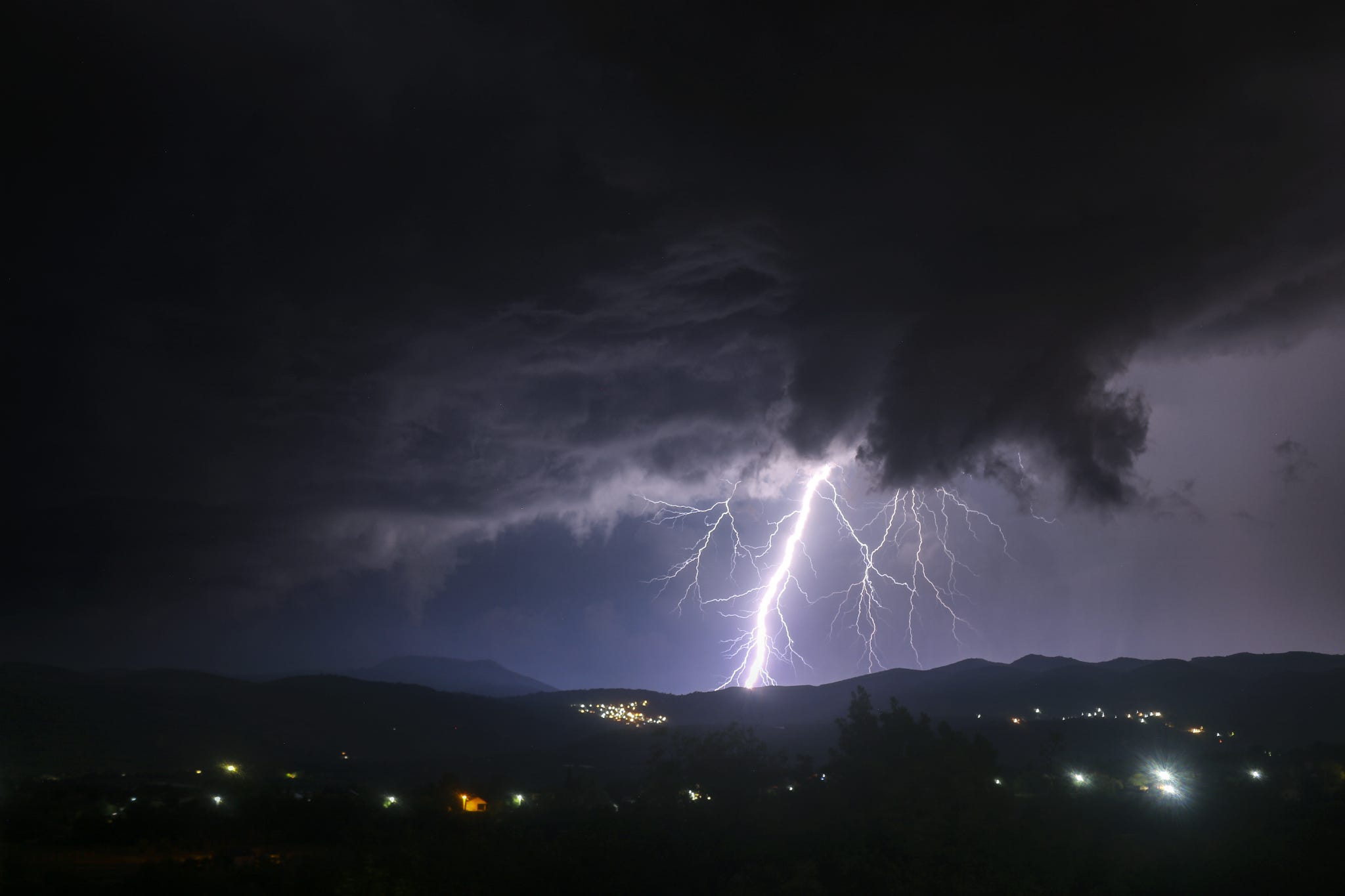
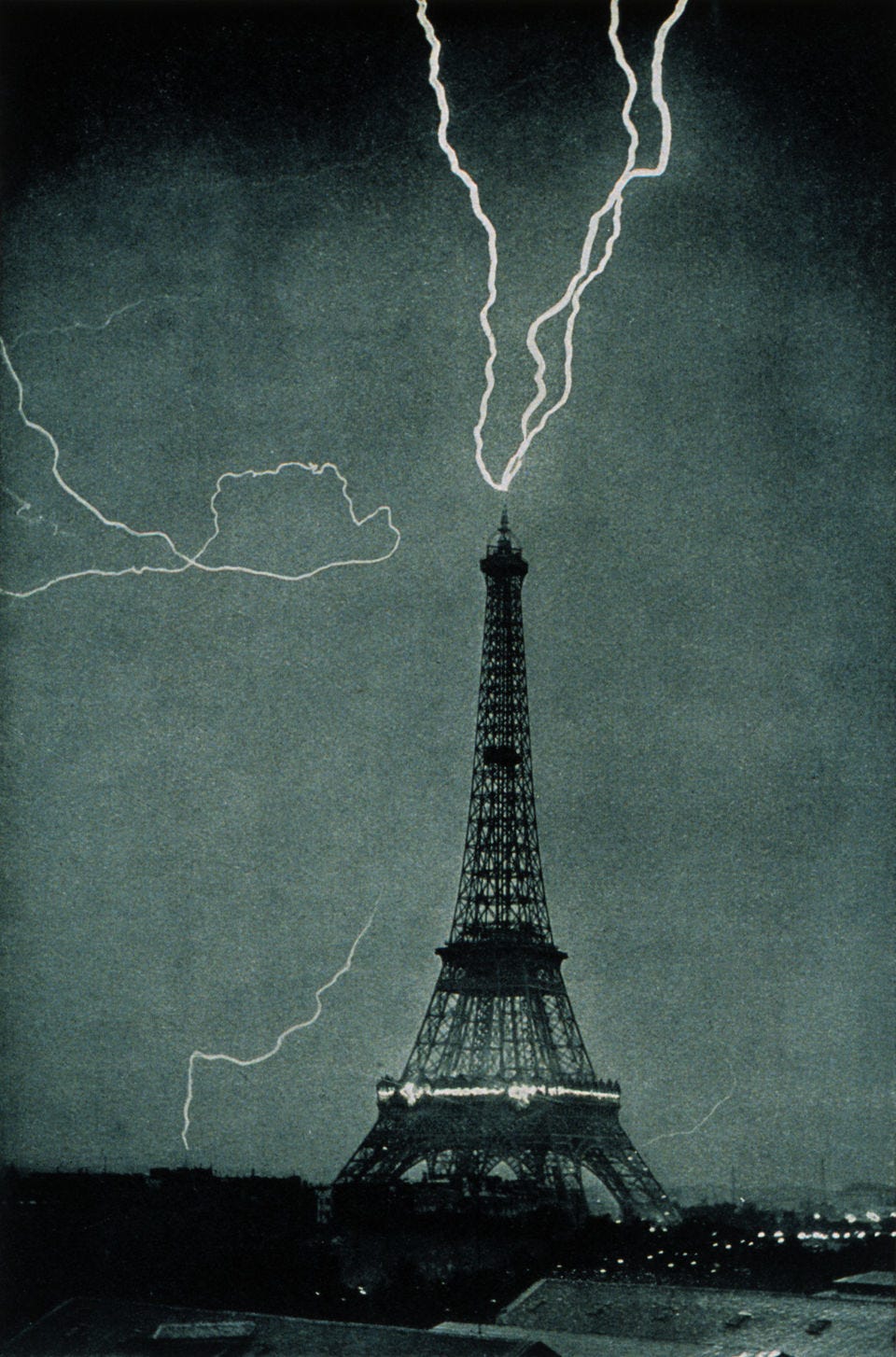
A storm cloud builds up a tension through electric charge which then produces a lightning flash. While the charge is the precondition, the path to ground of the lightning flash, and its timing are random and unpredictable. The flash can form from a plurality of paths of equal low resistance. There is no true determinism in how the lightning forms, the lightning strike simply emerges. The path to ground appears to be an improvised ‘decision’, that produces ‘form’ from ‘potentiality’. One can say the lighting was ‘caused’ by the electrical charge in a loose sense, but there is no direct discrete chain.
The same could be said for other forms of emergence from potential states, such as the wave-function collapse of light, from a wave (a ‘probability field’ without any discrete or fixed position), into a photon (particle) in space.
The event or form, like our lightning bolt or photon, appears “because it can” not “because it must”.
This line of thinking, and much stranger forms of non-linear causality must be harnessed to properly understand our universe. They also free us to think creatively and magically. It is my position, based on experience, that when you engage with the world magically, it responds magically, and when you engage with the world creatively it responds creatively. If this troubles you, remember we can treat these as heuristics (and our perception is built entirely of heuristics!).
I argue that Magic doesn’t ‘cause’ anything. Rather it is an invitation to meaning. A recognition of meaningfully relatable, but uncaused events. The result is a world full of opportunities.
We currently live in an era where this type of magic is creeping back into science from where it was once banished. Perhaps the dawn of new renaissance?
(JY) Are probabilities shaped by prior states though? Quantum mechanics appears non-causal in its standard formulation: wavefunction evolution is deterministic (Schrödinger equation), but measurement outcomes are acausal probabilities, uncorrelated with prior local states.
I understand these phenomena, as tensions ready to spring into form. They have no determinism in how they will become located, as in the example of the cloud and lightning bolt.
The exact path is not predictable, outside of very complex probabilities, which bely the simple form of a lightning bolt.
Our models of prediction are maps. Every map contains only the data that the map-maker wants you to pay attention to. Some maps of the Earth have walkways and roads, others have topography of mountains. Building a map of all the potentialities of the universe (all possible data) would require a space much much larger than the universe can contain1!
Aristotle’s five causes
Aristotle (384–322 BC) proposed four fundamental categories of causes, with an additional fifth wildcard. These are Material, Formal, Efficient and Final causes, plus Chance2.
Material Causes
These are explanations3 about what things are made of. E.g. an arched bridge made of stones or a computer image made of pixels4. This is the line of thinking that gave us reductionism.
Formal Cause
These are explanations5 pertaining to the forms things, or events can take. For instance how water poured into a container conforms to the shape of the container. Likewise, a bomb exploding a building quickly removes the building’s form, and produces the form of a ‘pile of rubble’ in its place.
Efficient Cause
These are ‘how did it come to be’ explanations6. For instance a craftsman’s methods for making furniture, or a cat’s hunting methods for catching a bird. Explanations via action.
Final Cause
These, are explanations based on goals or ‘teleology’7. I see these as retro-causal claims. We say that an acorn ‘wants’ to become a tree, because we understand the idea of a tree and work backwards. ‘Paths to ground’, such as our lightning bolt, are often explained this way. Evolution is also usually taught this way, for instance the question of how a whale evolved from a land mammal into an aquatic one.
This falls apart when we want to predict what any living creature is going to evolve into. The ‘decision’ is only certain after the fact. In my opinion it is better to consider evolution a great improvisation.
If you have never seen an oak tree, and you are given an acorn, you will never be able to deduce or predict precisely what the acorn will become8.
Of all these four causes, note that only the ‘efficient’ (‘how this came to be’) explanation must obey linear time: our classic cause-and-effect.
(JY) Is this just a limit of human conception of cause effect relations, a kind of highly simplified and abstracted map, as you say, but the land of highly complex, inter-relations, and inter influences of everything touching everything else. Hmm. What happens when you start thinking about what won’t cause something? I can’t bring about my birthday party by sitting by myself on a rock. I can’t grow this tomato seedling into a bird or carrot. Does this thought experiment give any results?
If we only ever observed gradual changes in form, then perhaps we could believe in the determinism of causes, where the causes have become a multitude. It is true that part of our limitation is a limit of how many things we can understand at one time.
However the measured universe also presents us with developments that don’t follow classical chains of cause and effect, as you will see in the next section of this article.
Chance
Aristotle’s ‘trump’ or wild card category is chance9. Probability and chance as well as ‘risk and protection from risk’, have always been vital human, and natural, concepts. Chance, as an unknown quantity has always been something that science has tried to eliminate from experiments and conclusions. Despite this, we have ended up with a standard model of the universe where chance and probability are inconveniently fundamental.
Alternatives to causality
Probability. This defeats pure determinism and perfect certainty. Some magicians define magic as ‘probability manipulation’. Namely the art of making things more or less likely to happen. This doubles as a nice way of avoiding having to explain cause and effect!
Probabilities are constrained possibilities, which never specify exact outcomes. In this way they are, for our purposes, ‘non-causal’. They can be considered ‘explanations by constraint’.
Mathematical constraints
These are laws about how information or energy may behave. In many cases we cannot provide causes for these constraints.
Examples of these in maths and science are ‘geometric’ explanations: For instance ‘Foucault’s pendulum’. This is a long, freely swinging pendulum that visually demonstrates Earth’s rotation. Its motion arises from the geometrical constraints of Earth’s rotation, and spacetime geometry, rather than chain of dynamical forces.

Phase transitions are similar: Water boils at 100°C (at sea level or a standard atmospheric pressure of 101.3 kPa) because of thermodynamic constraints and molecular statistics. Not from a step-by-step causal history.
Retrocausality.
This can present as ‘becoming’ or ‘teleos’ (a destined goal), where we work back from a present form. For instance how a kiwi ended up a flightless bird, from an earlier form capable of flight.

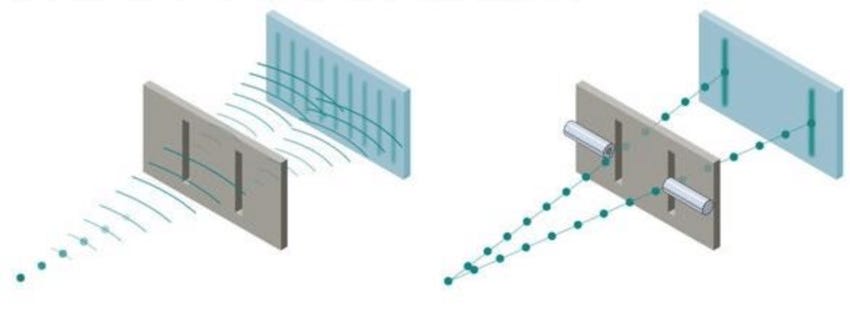
A more radical example can be found in some scientific results which show information travelling back in time to change prior events. Some of the double slit experiments have shown this: Where the outcome is hidden from the observer until after a wave/particle has chosen between one of two gates. In this instance the wave will ‘know’ which outcome the observer has seen ahead of time! It seemingly ‘retroactively’ becomes a single particle moving through a single gate, rather than a wave moving through two gates10.
Similarly, positrons, which are ‘antimatter’ versions of photons, are mathematically identical to a photon moving backwards in time!11
Dean Radin’s scientific tests on psi phenomena have also shown some retrocausality. Subjects who studied after a test were shown to have higher results than subjects who did no study at all. These results can be found in his book Real Magic.
Michael Levin’s ‘Free Lunches
The Biologist Michael Levin (b.1969) is applying the idea of mathematical and conceptual ‘platonic spaces’ to biological living creatures. He proposes that these informational ‘spaces’ are inhabited by conscious agents or ‘minds’.
The idea is that these informational entities, or ‘minds’ are always looking for ways to manifest. As such, rather than witnessing a gradual build up of organisation, we often witness things and phenomena ‘springing to form’ like our lightning bolt. Levin proposes that these are agents popping into physical space anytime they see an ‘interface’ that they might inhabit, and thereby organise. These ‘habitations’ coincide with a sudden jump in order, agency, cognition or intention.
This sounds a lot like spirits right? It does. However, Levin’s work is entirely grounded in laboratory testing.
Levin’s labs have succeeded in communicating electrical messages to multi-celled creatures (for instance, highly regenerative flatworms) which then reorganise themselves into new forms that have never been seen in nature, via electrical messages. This work has been able to reorganise the body layout of flatworms convincing them to grow two heads, or revert from two heads to one.

Levins group of scientists have also produced new creatures which he calls ‘xenobots’ (made of animal cells, for instance cells from frogs), and ‘anthrobots’ (made from human thyroid cells). These ‘bots’ operate in their environment with body layouts and behaviours that have never been seen in nature, as if they are ‘inhabited’ by forms that allow them to radically jump in complexity. Both xenobots and anthrobots have been shown to reproduce with these novel body layouts, which currently consist of both single cells and self organising bodies made of clusters of cells. They achieve all of this despite only containing DNA from their donor animals: Frogs and humans.
Levin’s work shows that organisational leaps can happen at the biological level, in a conceptually similar way to how particles can appear from probability fields in quantum physics.
Like an electrical path-to-ground, when the conditions are right, an event is improvised based on available paths. This is a major break from Newtonian ideas of causation. Levin’s ‘free lunches’, are his term for sudden jumps to higher organisation that are unpredictable from reductionist analysis (merely considering parts becoming wholes). These ‘free lunch’ leaps show real cognition and an unpredicted leap in complexity. It appears that many of these phenomena exhibit intelligence12.
Levin’s ‘minds’ from a proposed ‘platonic space’ constitute a ‘top down’ ordering in line with Plato’s ideas of forms and conceptual space, with one difference. Levin’s ‘Platonic space’ allows for change to occur in two directions. The forms (minds) are no longer eternal, as Plato described, but are rather, capable of change, being influenced, and learning. In Levin’s terms they are ‘minds’ ready to inhabit physical space, even when the situations and bodies they may inhabit have never been seen by nature before! These discoveries are revolutionising our understanding of evolution. No longer will a model of gradual changes be sufficient. We will need to recognise the ‘free lunches’ that ‘spring to form’ and suddenly gain complexity. Hypothesised as ‘minds’ inhabiting matter from a nonphysical (informational) space!
Levin doesn’t like the term ‘emergence’, as he equates it with ‘surprise’.
I see another way to understand ‘emergence’, and that is by the concept of one-way information. For instance, Gödels incompleteness theorems which are logical and mathematical proofs where an ordered system (or axiom) may only be fully understood when one takes an observation point outside of that system. We must stand outside an environment or organisational structure to fully understand it13.
The fact that our universe allows us to model these one-way systems, for instance with the constrained, but infinite novelty of fractals such as the Mandelbrot set, suggest that ‘emergent’ one-way information flows might be a part of how our universe is put together. These fractals can be generated by very simple codes, but the codes can never be deduced completely by simply showing the results they produce once run through a computer. They cant be reverse engineered.
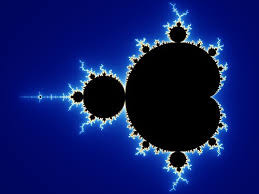
In this way, a lot of our universe, where it contains one-way information flows- may never be fully understandable to us from our natural vantage point inside it.
Synchronicity (appeals to narrative):
“Synchronicity means the simultaneous occurrence of a psychic state with one or more external events, which appear as meaningful parallels to the momentary subjective state.” — Carl Jung’s Collected Works Vol. 8, Para. 441
Synchronicities were defined by Carl Jung as an acausal, but meaningful connecting principles. Like our ‘springing to form’, synchronicities can be considered a ‘springing to meaning’.
My example concerns a young woman patient who, in spite of efforts made on both sides, proved to be psychologically inaccessible. The difficulty lay in the fact that she always knew better about everything. Her excellent education had provided her with a weapon ideally suited to this purpose, namely a highly polished Cartesian rationalism with an impeccably “geometrical” idea of reality. After several fruitless attempts to sweeten her rationalism with a somewhat more human understanding, I had to confine myself to the hope that something unexpected and irrational would turn up, something that burst the intellectual retort into which she had sealed herself. Well, I was sitting opposite of her one day, with my back to the window, listening to her flow of rhetoric. She had an impressive dream the night before, in which someone had given her a golden scarab-a costly piece of jewellery. While she was still telling me this dream, I heard something behind me gently tapping on the window. I turned round and saw that it was a fairly large flying insect that was knocking against the window from outside in the obvious effort to get into the dark room. This seemed to me very strange. I opened the window and immediately and caught the insect in the air as it flew in. It was a scarabaeid beetle, or common rose-chafer, whose gold-green color most nearly resembles that of a golden scarab. I handed the beetle to my patient with the words “Here is your scarab.” This broke the ice of her intellectual resistance. The treatment could now be continued with satisfactory results. -C.G. Jung.14
Jung is often criticised for trying to bypass causality through his concepts of synchronicities. I think this is wrongheaded, and misses the freedom being offered to us. I think Jung could have leaned into non-causality harder than he did, and that the conceptual power of synchronicities comes from their offer of an alternative to conventional causal thinking.
If this troubles you, consider synchronicities as narrative events that allow one opportunities to act. Jung explained that we are preprogrammed for meaning. It could be considered a property of our cognition. In this way, a synchronicity could be seen as an emotionally affecting ‘heuristic’ that allows us a sudden relief into understanding. In Jung’s practice, this was particularly effective in helping patients overcome cognitive dissonance, which is often experienced as an inability to find the type of meaning that allows emotions to resolve.
An event may arise from a multiplicity of causes that stack. Most of the time we can’t measure all of these (as JY pointed out previously). Like the lightning bolt, and Levin’s ‘minds from platonic space’, the synchronicity is a sudden spring to meaning. It need not involve any causal explanation, and yet it allows emotions or understanding a ‘path to ground’.
(JY) Change can be self-ordering, than being engineered.
Precisely.
Free will ‘libertarianism’
This is a philosophical stance in relation to the debate between free will and determinism.15
Hardline determinism sees all events in the universe, including our thoughts, and behaviour, as fixed causal chains (predestination).
Free will libertarianism argues that our behaviours and decisions are improvised and freely chosen, not predetemined.
Under free will libertarianism, each action by an agent is said to initiate a new causal chain, each of these free decisions is considered itself to be uncaused. We can be ‘prime-movers’.
A basic action is something you do “just by doing it” (e.g., deciding, trying, or mentally choosing), rather than by doing something else that produces it.
The hunger for certainty, always requiring a cause, defeats opportunity, and leads us into a regression of ‘who caused the causer’? Libertarianism simply answers this by making each agent, such as a conscious human, a ‘first causer’ unto themselves. This makes you an irreducible agent.
Experiencing memories
Our consciousness of memory doesn’t care about time that much. All memories are experienced in the present. A memory from any time past, can therefore be linked, or triggered by any present event.
Often an even happens and we construct a narrative for it afterwards. This narrative will be a memory that is triggered, and linked to the present even by meaning. There might only be a symbolic connection between the event and the memory rather than a linear causality.
The backburner
This is a magical harnessing of memory, or a type of conditioning, used in order to influence future opportunities or behaviour. For instance a person my pray to ‘see more green’ and end up acquiring more houseplants.
The usefulness of this is to affect one’s ‘reality tunnel’ or perception without locking it down to any precise action. Recently I cast a spell for more money, and was offered a deal out of the blue by an acquaintance to sell some music gear on her behalf at 50% commission. In one sense this type of magical thinking is putting a meaning out into the world, and trying to snag a result.
Time is produced by events
Causation is often linked to time, but time could be defined as sequential organisation of events. This would mean that without events, there can be no time. As such, there is a paradox here if one requires causation to be temporal (time-based).
One possible way to think outside of time based causation is to acknowledge, like Heraclitus, that many causes happen simultaneously with their events. A tug of war between two equally strong teams causes a rope to store tension. It’s not the case that one side pulls followed by the other side pulling back. Both forces are simultaneous yet they could both be said to cause the tension in the rope. In a sense the tension, as a potentiality to an event: for example the snapping of the rope or one team letting go, is non-temporal until an event happens.
Heraclitus’ Flux and Logos
Heraclitus (c. 500 BCE) saw reality as a flux, rather than as linear chains of causes. His conception of logos, the principle of recognisable form and order, was explained by him as an underlying harmony that does not operate mechanically. Similarly to our tug-of-war example, Heraclitus said that all order, is caused by a balanced union of opposites.
Adding to this, Empedocles (Approx 494 -443 BC) saw the universe as interactions and balances between ‘love’ (φιλότης -philótēs, a binding force) and ‘Strife’ (νεῖκος – neîkos a disordering force.).
In this line of thinking, all things are relational, and the only constant is flux: Change and potentiality for change. By logical extension, one could also say that time is caused by one thing reacting to another (either causally, or through meaning).
Quantum foam: The property of creativity.
In Physics, Quantum foam is short duration energy that is constantly bubbling in and out of existence in every part of the universe. This energy has no cause. This suggests that ‘emptiness’ is an instability in our universe, and that the universe is constantly creating itself in a kind of defiance against emptiness. Immanent expression rather than causality.
At its most abstract, I consider this evidence of ‘creativity’. The quantum foam suggests that creativity is a fundamental property of the universe. This fundamental ‘creativity’ is conceptually similar to ‘Brahman’, ‘Ein Sof’, ‘Chaos’, Te Kore’ and similar religious, mythological and philosophical concepts. This defiance of emptiness appears to be a fundamental ‘first cause’ in our universe.
David Hume
Hume (1711 – 1776CE) said that we never truly perceive causation, only coincidence:
“When I see an object precede and be contiguous to another, I immediately perceive that they are contiguous in time and place, and that the object we call cause precedes the other we call effect. In no instance is there perceived either connexion between the objects, or power or agency by which one is impelled to produce the other.” (Hume’s - Treatise of Human Nature, 1.3.2.6)
Causality is then for Hume, something we project onto reality, a psychological habit, not a provable assumption. We could say that he was a sceptic of fundamental causality.
What most people mistake for causality, Hume says is merely the “constant conjunction” of events. If the occurrence of A is always followed by B, A and B are said to be constantly conjoined. That is, there is no purely objective way to tell the difference between events that happen one after another and those where one causes another.
If this seems overly pedantic to you, you are not alone. There are many instances where A causes B is pragmatically true, if not perfectly true from an ‘a priori’16 standpoint.
Immanuel Kant
Kant (1724 – 1804) continued in this fashion of exercising radical doubt about causality. Like Hume he considered causality as a way of seeing rather than as a true reality: a mental structure applied to appearances.17
Despite this, Kant fights for the idea that we have free will, that our will can operate as a ‘first cause’ in a series of events and that we can therefore overcome determinism: Our actions are not necessarily ‘forced’ by prior events:
“When, for example, I, completely of my own free will, and independently of the necessarily determinative influence of natural causes, rise from my chair, there commences with this event, including its material consequences in infinitum, an absolutely new series; although, in relation to time, this event is merely the continuation of a preceding series. For this resolution and act of mine do not form part of the succession of effects in nature, and are not mere continuations of it; on the contrary, the determining causes of nature cease to operate in reference to this event, which certainly succeeds the acts of nature, but does not proceed from them. For these reasons, the action of a free agent must be termed, in regard to causality, if not in relation to time, an absolutely primal beginning of a series of phenomena.”18 -Kant
Friedrich Nietzsche
“The desire for “freedom of will” in the superlative, metaphysical sense, such as still holds sway, unfortunately, in the minds of the half-educated, the desire to bear the entire and ultimate responsibility for one’s actions oneself, and to absolve God, the world, ancestors, chance, and society therefrom, involves nothing less than to be precisely this causa sui, and, with more than Munchausen daring, to pull oneself up into existence by the hair, out of the slough of nothingness.”19
Friedrich Nietzsche critiqued Kant’s view that our decisions to act constitute a ‘causa sui’ (a self causing act). At the same time, just to be difficult, Nietzsche also fought against determinism. Instead he proposed that we are lead by a mixture of human and universal natural drives.
“there is no such substratum, there is no “being” behind doing, working, becoming; “the doer” is a mere appanage to the action. The action is everything.” -The Genealogy of Morals (1887 ), Translated by Horace B. Samuel (1913).
Nietzsche portrays actions as eruptions from a flux of competing drives. What we usually refer to as ‘free will’, is whichever drive becomes dominant enough to control our actions in the moment.
We can however affect how future drives will move us by how we respond. We have some ability to reorder our drives with discipline. This is a longer game than the idea that we decide what we do in every moment. It is like training a horse to be ridden. In this analogy we are the horse, the rider and the terrain.
Nietzsche’s idea of causality is more like a weather system, with competing pressures, than it is like a mechanical linkage of ‘A causes B’ chains.
Again, events and actions are considered like a buildup of charge followed by an erupting path to ground, without discrete determinsm.
Magic: Claiming your liberty
Magical thinking offers us permission to move beyond cause and effect. It can allow us to recognise structures of meaning that might have no causal relationship. It is the application of creativity to the way we perceive the world, a type of ‘active meaning making.
Where objectivity and rationalism can sometimes paint us into a corner, magic offers us a way out of the mire, via ‘good enough’ heuristics. When specifics trap us, abstractions may free us. Magic is granting yourself permission to leaps to top down explanations such as personification (gods and spirits) and ‘spooky’ coincidences (Carl Jungs synchronicities).
This is both dangerous and responsible. The best magicians never treat beliefs as dogmas, but rather as tools. Like a musician who charms their audience to dance, a magician woos reality.
If one is not careful, one might think we can be talked into anything. Yet even something as bold as ‘cause and effect’ may be bypassed, at least conceptually. There is one pillar of realty that allows us to understand how fluid reality is, without being swept away by ‘nothing is real/everything is real’. That is results, results, results.
The lightning bolt erupts from the cloud!
This ‘Space’ could either informational, as in a digital map on a computer, or physical, such as a map on paper.
Aristotle’s word aitia (αἰτία) “cause’ or “explanation.”
Material causes: ὕλη (hýlē) Matter/substrate
The image is actually an illusion put together by your vision, rather than being ‘in’ the pixels, and this could be said of all vision. Despite this, we generally accept, as a heuristic, that your computer or phone ‘stores pictures’.
Formal causes: εἶδος (eîdos) or μορφή (morphḗ). Form/essence
Efficient causes: ἀρχὴ τῆς κινήσεως (archḗ tês kinḗseōs) or ποιητικόν αἴτιον (poiētikón aítion). Source of change.
Final causes: τὸ οὗ ἕνεκα (tò hoû héneka). Purpose.
And no two oak trees are truly alike.
Τύχη (týchē). Random chance opposing deliberate action.
Wheeler’s, delayed choice thought experiment, now realised.
Ernst Stueckelberg (1942) and Richard Feynman (1949) independently discovered this, both basing their work on Paul Dirac’s prediction (1930).
Levin likes to use William James’ definition of intelligence, which is often summarised thus: “Intelligence is a fixed goal with variable means of achieving it.”
‘You can’t see the forest for the trees’.
p. 32-33, Jung, C.G. (1960) Synchronicity: An Acausal Connecting Principle. Princeton University Press. New York.
This is an entirely separate philosophy from ‘political libertarianism’.
A priori knowledge is that which is independent of any experience. For examples mathematics, tautologies and deductions from pure reason.
The counter term is A posteriori, which is knowledge which depends on empirical evidence.
From Critique of Pure Reason (Second Analogy, A189/B232):
“Everything that happens, that is, begins to be, presupposes something from which it thus follows in accordance with a rule. [...] Therefore, since that which happens follows in conformity with the concept of causality of that which is temporally determined through something else which precedes it in time, it necessarily follows that the apprehension of that which happens follows upon the apprehension of that which precedes it in conformity with a rule of time.”
P. 187 Kant, Immanuel. (1781) Critique of Pure Reason. Hartknoch. Riga. (Translated by J. M. D. Meiklejohn).
Link
P. 21 Nietzsche, Friedrich. (1886 ) Beyond Good and Evil. Naumann Leipzig. (Translated by Helen Zimmern
“Defiance of emptiness” reminds me of Kurt Vonnegut’s Universal Will To Become, from the only book he fully enjoyed writing, The Sirens of Titan.